

In the high-stakes arena of family law, the phrase "tit for tat" often conjures images of petty squabbles over kitchen appliances or vindictive and bitter text messages. However, when viewed through the lens of a litigation strategy, "Tit for Tat" is actually one of the most successful strategic frameworks that can be utilized in a family law case. Obviously, in a case where the parties can work together cooperatively and resolve things through mutual compromise, mediation and collaboration are a better strategy. However, in cases where parties do not cooperate, tit for tat litigation can set a framework for a successful litigation process.
In a contested divorce or child custody case, this strategy isn't about being mean—it’s about consistency, predictability, boundary setting, and creating incentives for cooperation.
What is the "Tit for Tat" Strategy?
Originally popularized by political scientist Robert Axelrod, Tit for Tat is a simple algorithm for the "Prisoner’s Dilemma." It follows four golden rules:
- Be Nice: Start by cooperating (don't strike first).
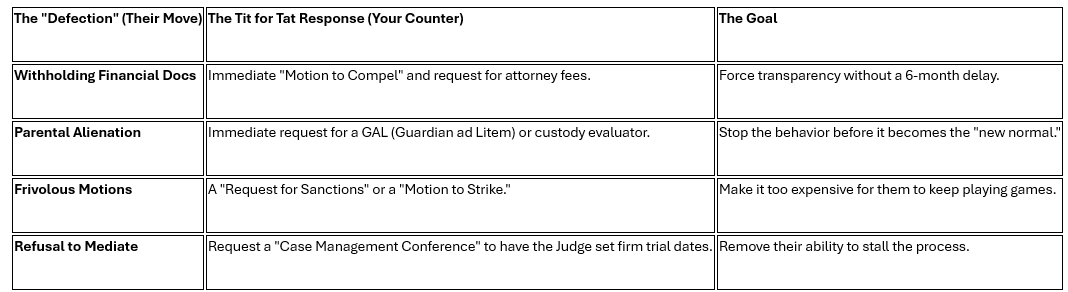
- Be Provocable: If the other side "defects" (with such behaviors as lies, hidden assets, or denying visitation), respond immediately with a proportional legal counter-move.
- Be Forgiving: If the other side returns to cooperating, you return to cooperating immediately.
- Be Clear: Make sure the other side knows exactly why you are reacting so that hopefully the maneuvers outlined above can be avoided in the future.
In litigation, this translates to: “I will be the most reasonable person in the room until you try to take advantage of me, at which point, I will meet your aggression with equal legal force.”
Why It Works in a Contested Case
Many litigants make the mistake of either being too soft (hoping "niceness" will be rewarded and/or successful) or too aggressive (scorched-earth tactics that annoy judges and can create years of disharmony in the family unit). Tit for Tat finds the "sweet spot" of effectiveness.
1. It Establishes Boundaries
If your ex-spouse denies you a scheduled weekend of parenting time and you do nothing, you have set a precedent that your rights are negotiable. You start down a long-term path of them taking action and you being the victim for what they decide. A Tit for Tat response—such as an immediate motion for "make-up time" or a contempt filing—signals that every "defection" has a cost and an equal response.
2. It Conserves Judicial "Social Capital"
Judges dislike "nuclear" or extreme litigants who file a motion for every minor slight. However, they respect litigants who only escalate when provoked. By using Tit for Tat tactics, you show the court that you are a reactive litigant, not an instigative one. This builds credibility when you finally do ask the judge for a significant ruling.
3. It Forces the Other Side to Rationalize
Aggressive "Bullying" tactics rely on the victim folding. When you mirror their tactics proportionately, the "bully" realizes that their aggression is only resulting in higher legal fees and well-reasoned, well-measured legal responses and will yield no net gain. This often forces the aggressor back to a more reasonable baseline and back to the mediation table.
Tactical Execution: From Custody to Assets
How does this strategy look in practice? Below is a comparison of how Tit for Tat handles common litigation "defections."
The "Silver Bullet" Warning
While Tit for Tat is an effective litigation strategy, you must avoid the "Silver Bullet Method"—the use of false allegations (such as abuse) to gain an immediate advantage. In a Tit for Tat framework, if the other side makes a false allegation, your response should be evidentiary, not retaliatory. For example, if they lie, do not lie back. Instead, "Tit for Tat" their lie by filing a motion to expose their lack of credibility. Being successful and "effective" in litigation is about being the more reliable narrator to the judge- not playing games.
How to Win Using This Strategy
To "win" using Tit for Tat, you must maintain a "Generous" version of the strategy. This means:
- Don't Over-Retaliate: If they are 15 minutes late for a drop-off, don't file a contempt motion. That is "Over-Reacting."
- Communicate the "Why": Have your attorney send a "Good Faith" letter: "My client was willing to settle for X, but since you have chosen to litigate Y, we are now forced to seek Z."
- Reward Cooperation: If they finally provide the documents you asked for, drop the pending motion to compel immediately. This reinforces that cooperation is the easiest path for them.
Conclusion
The Tit for Tat strategy is effective because it removes the "emotional" element of the divorce or other family law litigation and replaces it with a logical "if/then" system. It protects you from being a doormat while preventing you from looking like the villain in the eyes of the court.
If you are in a difficult family law litigation process or you anticipate going through a difficult process, call Pingel Family Law today. Allow one of our knowledgeable and experienced family law attorneys to help create the right strategy for your case to try to maximize your opportunity for success.